Multiplication & division · Grades 3–4

Times-table fluency your students actually want to practice.

Six games, one set of facts. Students win squishy friends for every table they master, and every miss comes back as a said-aloud fact. You get a class roster, assignments, and a mastery grid.

The free version needs no login and works on any iPad or Chromebook. Classes, rosters, and assignments are the school edition.

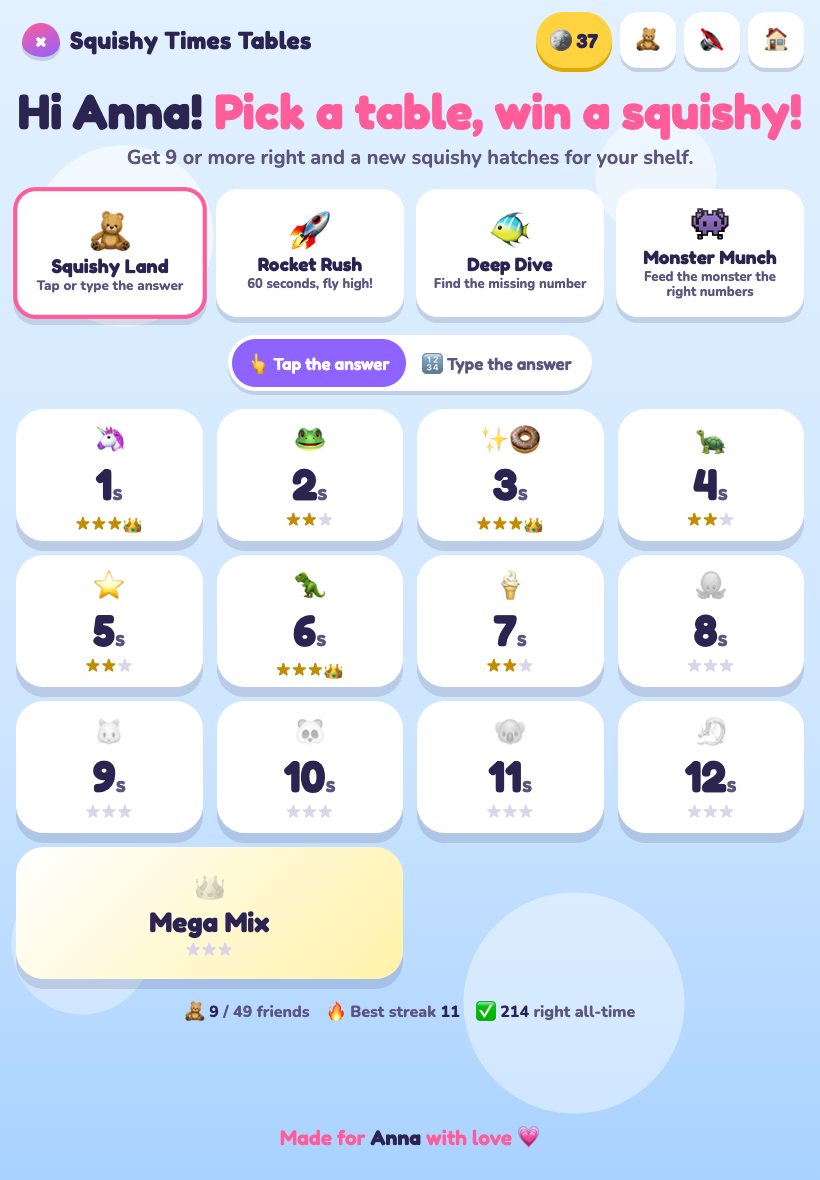
The student home screen: a greeting by name, four world tiles, and a 4-by-3 grid of times tables 1 through 12, each showing the friend earned and a star rating.
Made for 3rd graders

How it works

Set up a class in the time it takes to hand out iPads.

1

Create a class

Name it, and you get a class code for the board. Turn on Double Points Day or a class leaderboard whenever you like.

2

Upload your roster

Drop in a .csv or .xlsx with names. We generate usernames and 4-digit PINs, show you a preview, and give you printable login cards. Or paste names one per line.

3

Assign, then watch it sync

Assign a world or specific tables with a due date. Mark it ×2 points or extra credit. Students log in once on any device and their progress follows them.

The games

Six ways to practice the same 144 facts.

Every world drills the 1s through 12s. What changes is the task, so a student who has memorized 7 × 8 also has to find the missing factor, spot multiples, and divide.

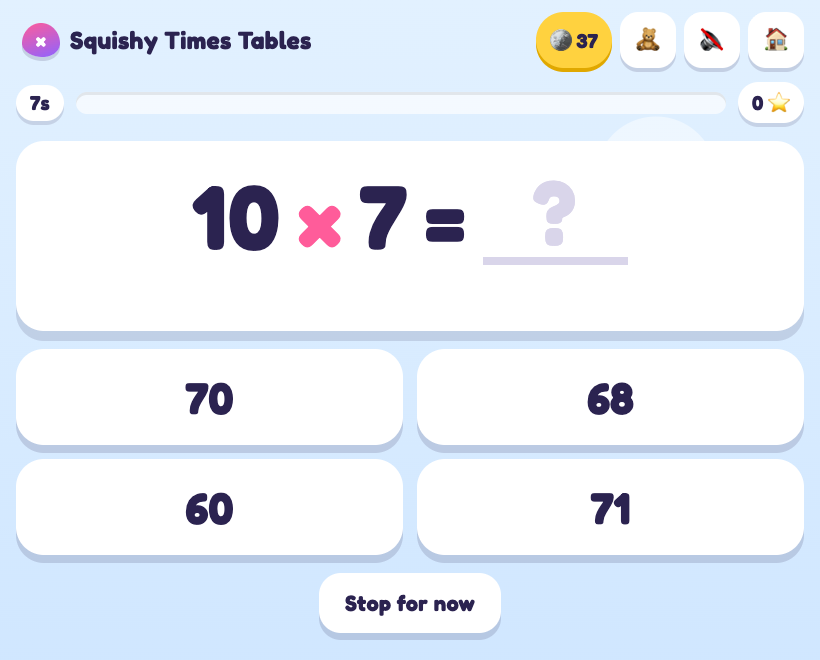
A Squishy Land question: 7 times 8 equals blank, with four large answer buttons.

🧸Squishy Land

Tap or type the product. Twelve questions per table, both orders (7 × 4 and 4 × 7).

Fact recall. Nine of twelve right earns the table's squishy friend; a perfect round earns a golden one.

A miss shows the fact, says it aloud, requires the student to tap "say it," and re-asks it a few questions later.
3.OA.C.73.OA.B.5
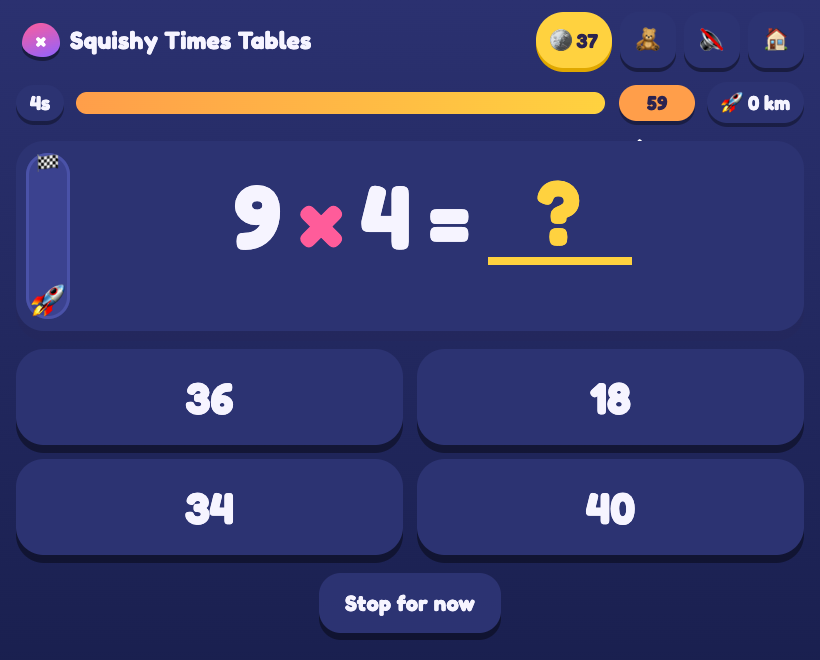
A Rocket Rush question on a starry background with a 59-second countdown and a rocket lane on the left.

🚀Rocket Rush optional

A 60-second sprint. Each right answer pushes the rocket higher.

Speed on facts the student already knows. Twelve right in a minute earns a space buddy.

Timed play is unlocked and assigned by you, never required. Misses simply show the answer and move on.

3.OA.C.7
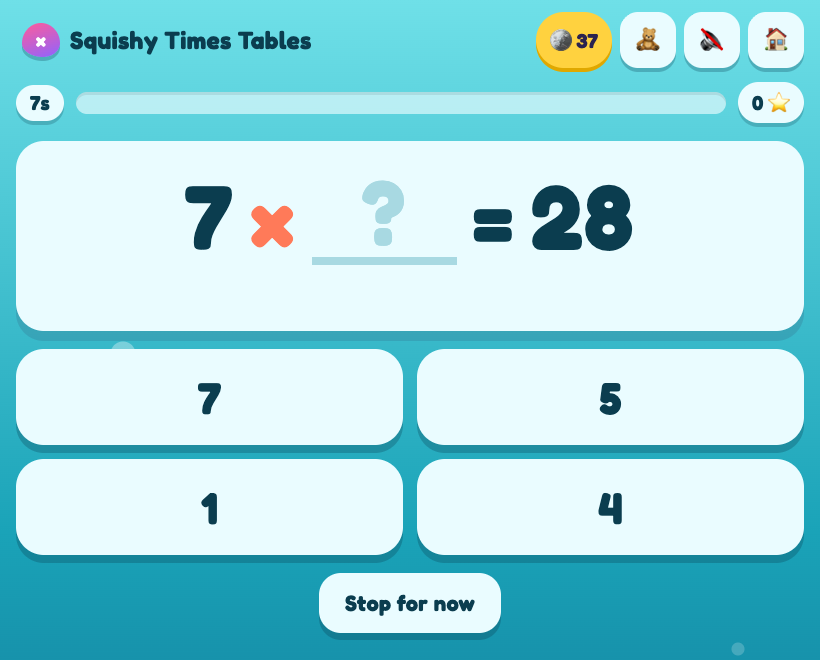
A Deep Dive question on an ocean background: 7 times blank equals 56, with four answer choices.

🐠Deep Dive

Find the missing factor: 7 × ? = 56.

The unknown-factor form of division. Same twelve-question round, same friends-for-mastery rule.

Students who can only recite forwards get stuck here, which is exactly the gap this world closes.

3.OA.A.43.OA.B.6
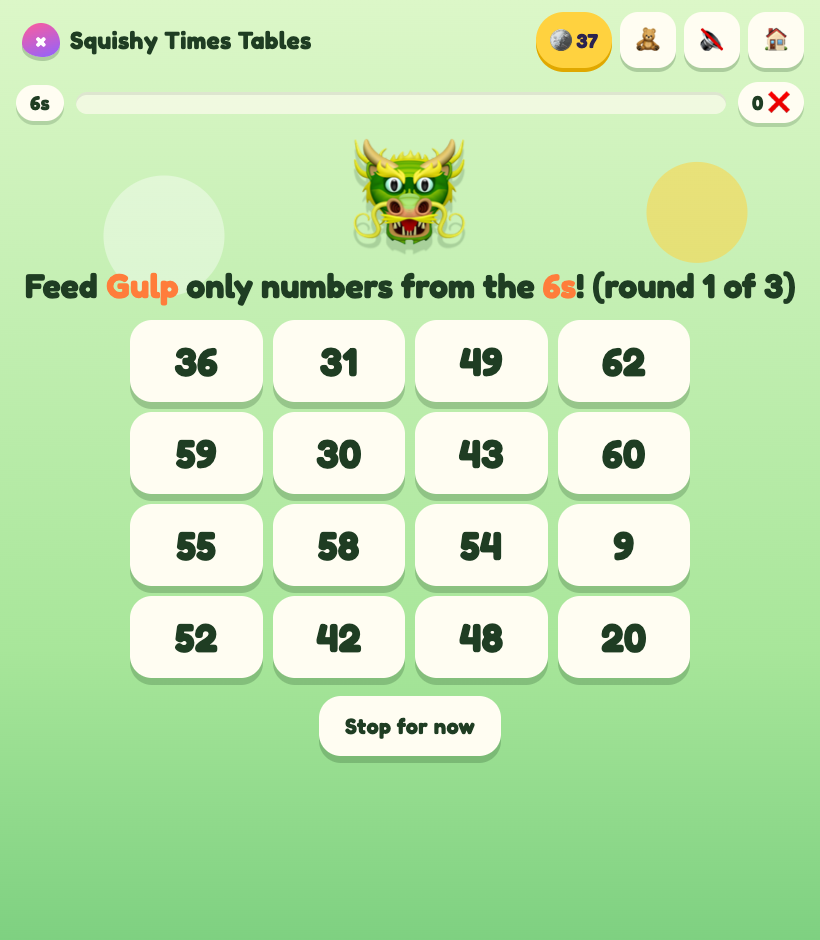
Monster Munch: a hungry monster above a 4-by-4 grid of numbers, only some of which belong to the 6s table.

👾Monster Munch

Feed the monster only numbers from the table. Six multiples hide among ten decoys, three rounds.

Recognizing multiples and near-misses (41 vs 42) rather than producing a single answer.

Decoys are built from neighboring products, so guessing by "looks about right" does not work.

4.OA.B.43.OA.D.9

🍕Division Dash

56 ÷ 7 = ? with choices from 1 to 12, or typed.

Division facts within 100, paired with the multiplication facts the student already has.

The voice says "56 divided by 7 is 8" on every miss, and the fact is re-asked in the same round.

3.OA.A.23.OA.C.7

🧩Puzzle Corner

Five short puzzle types: Skip Count, True or False, Bigger Bubble, Mystery Number, Balance the Scale. A Daily Puzzle runs one of each.

Patterns in the table, equivalence (3 × 8 = 4 × ?), comparison, and reasoning from clues.

Puzzles are the natural extra-credit assignment: short, varied, and hard to brute-force.

3.OA.D.93.OA.B.54.OA.A.14.OA.B.4

Standards alignment

Where each game sits in the California standards.

California's adopted mathematics standards are the Common Core State Standards for Mathematics (CA CCSSM). The Grade 3 Operations and Algebraic Thinking cluster is the core of this app; two Grade 4 standards cover the pattern and multiples work.

GameWhat the student doesCA CCSSM standard(s)Mathematical practices
Squishy LandProduces products for one table, in both orders3.OA.C.73.OA.B.5MP6, MP8
Rocket RushProduces known products under a light time limit (teacher-assigned)3.OA.C.7MP6
Deep DiveFinds the unknown factor in a × ? = c3.OA.A.43.OA.B.6MP1, MP7
Division DashFinds quotients within 100 for one divisor3.OA.A.23.OA.C.7MP6, MP8
Monster MunchIdentifies which numbers are multiples of a one-digit number4.OA.B.43.OA.D.9MP7
Puzzle Corner: Skip CountFills the missing term in 7, 14, __, 283.OA.D.9MP7, MP8
Puzzle Corner: Balance the ScaleSolves 3 × 8 = 4 × ?3.OA.B.53.OA.A.4MP1, MP7
Puzzle Corner: Bigger BubbleCompares two products (6 × 7 vs 5 × 9)4.OA.A.1MP1, MP6
Puzzle Corner: Mystery NumberFinds a number from clues about its table, range, and parity4.OA.B.4MP1, MP7
Puzzle Corner: True or FalseJudges whether an equation is correct3.OA.C.7MP6
3.OA.A.2 Interpret whole-number quotients
3.OA.A.4 Determine the unknown number in a multiplication or division equation
3.OA.B.5 Apply properties of operations (commutative, associative, distributive)
3.OA.B.6 Understand division as an unknown-factor problem
3.OA.C.7 Fluently multiply and divide within 100; know from memory all products of two one-digit numbers by end of Grade 3
3.OA.D.9 Identify arithmetic patterns, including in the multiplication table
4.OA.A.1 Interpret a multiplication equation as a comparison
4.OA.B.4 Find factor pairs; recognize a number as a multiple of a one-digit number

About timed practice

California's 2023 Mathematics Framework asks that fluency grow out of understanding, strategies, and practice with feedback, and it cautions against the anxiety that timed drills can produce. This app follows that lead: the default worlds have no clock, a miss always becomes a fact the student sees, hears, says, and meets again in the same round, and the one timed world (Rocket Rush) is something you choose to assign, not a gate students must pass.

Why it helps

Practice that behaves the way memory research says it should.

Built into every round

  • Retrieval, not re-reading. The table is available to peek at, but the round asks the student to pull the fact from memory, with answers hidden by default in the flash-card view.
  • Misses come back. A wrong answer is re-asked two to four questions later, in the table's own order, so the correction is tested before the round ends.
  • Immediate, specific feedback. The correct fact appears at once, is read aloud, and the student taps "say it" before moving on.
  • Both orders. About a third of questions are flipped (4 × 7 for the 7s), so commutativity is practiced rather than assumed.
  • Low-stakes rewards. Squishy friends, hats, and coins reward finishing and mastery. Nothing is taken away for a miss.

What you see

  • Mastery grid 1–12 per student. Best star rating for each table across worlds, so gaps are visible at a glance.
  • Assignment completion. Who finished, with how many stars, and when.
  • Live activity. Rounds as they finish, useful during a station rotation.
  • Points you control. Double Points Day for the class, ×2 on a single assignment, or extra credit worth a flat bonus.

For teachers and schools

The dashboard does the boring parts.

Teacher dashboard

  • Roster upload from CSV or Excel, with a preview before anything is created
  • Printable login cards: name, username, PIN, and the site address
  • Assignments by world or by specific tables, with due dates
  • Double Points Day and per-assignment ×2
  • Extra credit assignments with a flat bonus
  • Class leaderboard you can show or hide
  • Per-student mastery grid, points, friends collected, last active
  • Password reset and student removal in one click

School admin

  • Counts of teachers, students, and classes; rounds per day; who is active right now
  • Create teacher accounts, reset passwords, disable or remove users
  • Live activity feed across the school
  • "Login as" any user to see exactly what they see, then return

Privacy and practicality

  • Students sign in with a username and PIN. No email, no third-party accounts.
  • Progress is saved to the student's account and syncs across devices. Play continues offline and syncs when back online.
  • Runs in the browser on iPad, Chromebook, or a laptop. Installs to the home screen as an app.
  • A free public version is available for practice at home, no account needed.

Questions

Frequently asked

What grade is this for?

It is built for third grade, where students are expected to know products of one-digit numbers from memory by the end of the year, and for fourth graders who still need fluency or the multiples work. The 11s and 12s go a little past the standard and are there because most classrooms teach them.

Do students need an email address or a Google account?

No. Each student gets a username and a PIN from your roster upload. They sign in once on a device and stay signed in.

What is in the spreadsheet?

At minimum a column of names. Columns named first, last (or a single name column), username, and password or PIN are recognized in any order. Anything you leave out is generated. You see a preview before students are created, and you can download login cards afterwards.

Does it work without Wi-Fi?

Once the game has loaded, it keeps working offline. Finished rounds are queued and sent to the class record the next time the device is online.

Is the timed game required?

No. Rocket Rush unlocks after a student has earned a couple of friends, or when you assign it. Everything else has no clock. Misses in Rocket Rush are not penalized; they just show the answer.

Can families use it at home?

Yes. Students can sign in with their class login at home, and the free public version needs no account at all.

Ready when your roster is.

Sign in, create a class, and upload your list. Your students can be earning their first squishy before the end of the period.